

EY Future Workplace Index reveals surprisingly rosy attitudes on commercial real estate investment despite economic tightening

EY Future Workplace Index reveals surprisingly rosy attitudes on commercial real estate investment despite economic tightening

Index finds that 58{0cd64a0a8f98edc6e1a333a4649a39f4fde229418ea626ab6b5ac18b9de2691d} of US C-suite and business leaders will invest in real estate decision-making amid the current inflation and interest rate environment 

NEW YORK, Nov. 16, 2022 /PRNewswire/ — Ernst & Young LLP (EY US) today announced the launch of its second annual EY Future Workplace Index (the Index), which tracks executive sentiment and behavioral data around the workplace of the future. The survey reveals surprisingly optimistic attitudes from company leadership on real estate investment despite economic tightening.

The US economy is undeniably cooling, and a recession is anticipated in 2023. However, regardless of investment decisions, the macroeconomic outlook is forcing leaders to scrutinize their office portfolios from a new perspective. Amid the current inflation and interest rate environment, the Index found that just 33{0cd64a0a8f98edc6e1a333a4649a39f4fde229418ea626ab6b5ac18b9de2691d} of US C-suite business leaders will downsize their investment in commercial real estate, while 58{0cd64a0a8f98edc6e1a333a4649a39f4fde229418ea626ab6b5ac18b9de2691d} say they will invest in commercial real estate, which could include enhancing or expanding the real estate footprint.

“The economic downturn will force leaders to make important decisions regarding their real estate portfolios — from investments, to space optimization, to workforce models,” says Mark Grinis, EY Americas Real Estate, Hospitality & Construction Leader. “Employers are beginning to understand that they need to earn the commute time of their employees, and many are investing in the ‘office of the future’ to achieve this.”

The latest EY Future Workplace Index also reveals the following:

  • More than 70{0cd64a0a8f98edc6e1a333a4649a39f4fde229418ea626ab6b5ac18b9de2691d} of employees are working from home at least two to three days a week. This is up from last year’s Index, which found that only about 42{0cd64a0a8f98edc6e1a333a4649a39f4fde229418ea626ab6b5ac18b9de2691d} of employers were using a hybrid approach. New and complicated working patterns have a major effect on a company’s real estate strategy, including the amount of office space required and the cost of using that space. Almost 60{0cd64a0a8f98edc6e1a333a4649a39f4fde229418ea626ab6b5ac18b9de2691d} are either using, or will soon be using, reservation systems for space utilization and/or occupancy tracking.
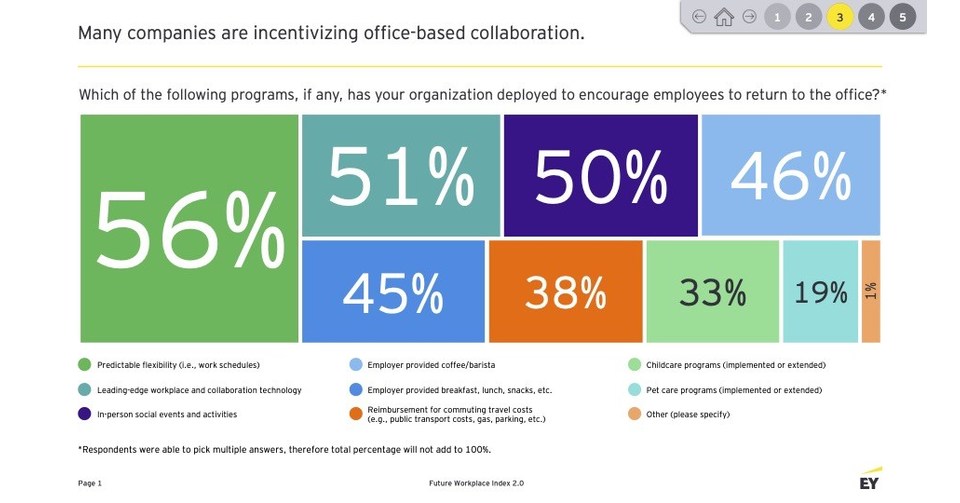
  • Of survey respondents, 64{0cd64a0a8f98edc6e1a333a4649a39f4fde229418ea626ab6b5ac18b9de2691d} are either leasing or considering leasing suburban office space since the pandemic. Employers have responded to the deurbanization of the workforce seen during the pandemic by investing in hyperlocal offices to promote a return to the office. The physical office is still a crucial component to a company’s ability to thrive now and in the future, and employers believe the connection employees experience within the physical office is worth the investment. In addition to predictable flexibility, companies are also investing in other avenues, such as in-person events (50{0cd64a0a8f98edc6e1a333a4649a39f4fde229418ea626ab6b5ac18b9de2691d}), providing meals (45{0cd64a0a8f98edc6e1a333a4649a39f4fde229418ea626ab6b5ac18b9de2691d}), reimbursement for commuting costs (38{0cd64a0a8f98edc6e1a333a4649a39f4fde229418ea626ab6b5ac18b9de2691d}) and childcare support programs (33{0cd64a0a8f98edc6e1a333a4649a39f4fde229418ea626ab6b5ac18b9de2691d}), to encourage employees to come into the office.
  • Sixty-four percent of executives believe flexible working options motivate employees. A mix of flexibility and technology in the workplace is top priority. Most are looking at the use of health and wellbeing management apps and other hybrid work technologies, such as digital and virtual collaboration resources, to optimize the workplace. For example, 44{0cd64a0a8f98edc6e1a333a4649a39f4fde229418ea626ab6b5ac18b9de2691d} of company leadership have activated or are beginning to invest in the metaverse for social interaction, training and/or recruiting purposes, and 62{0cd64a0a8f98edc6e1a333a4649a39f4fde229418ea626ab6b5ac18b9de2691d} have activated or are beginning to invest in health and safety innovations and monitoring, such as indoor air quality, touchless offices, etc.
  • Of the companies surveyed, 40{0cd64a0a8f98edc6e1a333a4649a39f4fde229418ea626ab6b5ac18b9de2691d} have either started using a four-day workweek or are in the process of implementing one. A prolonged, tight labor market and changing work patterns have employers doing all they can to attract and retain their workforce, and many are adjusting the role of the office to stay competitive. A company’s overall working model must accommodate hybrid working or risk employees searching for more flexible options. The Index found that 69{0cd64a0a8f98edc6e1a333a4649a39f4fde229418ea626ab6b5ac18b9de2691d} of company leadership has implemented or is in the process of implementing hybrid work technologies (video collaboration platforms, virtual whiteboards, etc.) to meet employees where they are.

“Data is paramount to understanding your workforce and creating the best space for a new era of work,” says Francisco J. Acoba, Principal, EY Americas Strategy and Transactions; Co-lead – Corporate Real Estate Consulting and Technology. “Data-driven insights that uncover employees’ work habits will shape how executives design and approach the workplace moving forward.”

To learn more about the EY Future Workplace Index, please visit EY Workplace reimagined.

About EY 
EY exists to build a better working world, helping to create long-term value for clients, people and society and build trust in the capital markets. 

Enabled by data and technology, diverse EY teams in over 150 countries provide trust through assurance and help clients grow, transform and operate. 

Working across assurance, consulting, law, strategy, tax and transactions, EY teams ask better questions to find new answers for the complex issues facing our world today. 

EY refers to the global organization, and may refer to one or more, of the member firms of Ernst & Young Global Limited, each of which is a separate legal entity. Ernst & Young Global Limited, a UK company limited by guarantee, does not provide services to clients. Information about how EY collects and uses personal data and a description of the rights individuals have under data protection legislation are available via ey.com/privacy. EY member firms do not practice law where prohibited by local laws. For more information about our organization, please visit ey.com.

Ernst & Young LLP is a client-serving member firm of Ernst & Young Global Limited operating in the US.

About the EY Future Workplace Index The EY Future Workplace Index anonymously surveyed more than 500 US C-suite and business leaders spanning a multitude of industries.

Media contact:
Elizabeth Feigenbaum
[email protected] 

SOURCE EY

Where do the wealthy invest? Luxury real estate is the safest investment one can make, says new Coldwell Banker Global Luxury report

Where do the wealthy invest? Luxury real estate is the safest investment one can make, says new Coldwell Banker Global Luxury report

U.S. affluent consumer sentiments, highlighted in “The Trend Report,” identifies the top trends and investment habits revolutionizing the global luxury real estate landscape

MADISON, N.J., Oct. 24, 2022 /PRNewswire/ — A recent report indicates that real estate remains in a strong position for the remainder of 2022 and heading into 2023 as more affluent consumers are turning to real estate to diversify their portfolios and as a long-term investment strategy. In fact, 80{0cd64a0a8f98edc6e1a333a4649a39f4fde229418ea626ab6b5ac18b9de2691d} of U.S.-based high-net-worth consumers agree that real estate is a safe investment, and over one-third agree that it is the safest investment one can make when compared to stocks, bonds, cryptocurrency and pensions, according to “The Trend Report,” released today by Coldwell Banker Real Estate LLC, an AnywhereSM (NYSE: HOUS) brand, and the Coldwell Banker Global Luxury® program.

Additionally, consumers are over three times more likely to think that 2023 will be a better time to invest in real estate compared to 2022 – rising a whopping 42{0cd64a0a8f98edc6e1a333a4649a39f4fde229418ea626ab6b5ac18b9de2691d} from only 11{0cd64a0a8f98edc6e1a333a4649a39f4fde229418ea626ab6b5ac18b9de2691d} a year ago.

The Trend Report, paired with a survey conducted by Censuswide of over 2,000 U.S.-based high-net-worth consumers, insight from Coldwell Banker Global Luxury Property Specialists and data collected by the Institute for Luxury Home Marketing and Wealth-X, provides an in-depth analysis of what’s driving real estate investment, emerging worldwide luxury real estate market trends, market growth opportunities and global wealth.

The top trends shaping the 2022 luxury real estate market:

  1. An Unconventional Buyer’s Market
  2. Smaller Square Footage
  3. Reconsidering Relocations
  4. Searching for Stability
  5. Moving Beyond Borders
  6. Creative Financing

A consistent theme throughout The Trend Report, as found through the survey findings, is that investment is continuously top-of-mind for the wealthy, no matter the market environment. Affluent consumers consider real estate a prime asset for building, maintaining and growing wealth.

Key survey findings featured in The Trend Report include:

  • Property investment is a priority
    Traditionally seen as a hedge against inflation, real estate has the ability to provide financial, emotional and psychological stability in the face of rising uncertainty. Over time, most home values typically appreciate, underscoring how much affluent consumers play the long game when it comes to financial and lifestyle investments today.
    • The top reasons respondents purchased real estate as an investment:
      • Diversify their portfolio (46.7{0cd64a0a8f98edc6e1a333a4649a39f4fde229418ea626ab6b5ac18b9de2691d})
      • Long-term investment (46.1{0cd64a0a8f98edc6e1a333a4649a39f4fde229418ea626ab6b5ac18b9de2691d})
      • Financial gain from rental income (45.9{0cd64a0a8f98edc6e1a333a4649a39f4fde229418ea626ab6b5ac18b9de2691d})
      • Inheritance for their children (45.3{0cd64a0a8f98edc6e1a333a4649a39f4fde229418ea626ab6b5ac18b9de2691d})
    • The top five types of homes respondents own as an investment property:
      • Multifamily Home (39{0cd64a0a8f98edc6e1a333a4649a39f4fde229418ea626ab6b5ac18b9de2691d})
      • Single-family home (34{0cd64a0a8f98edc6e1a333a4649a39f4fde229418ea626ab6b5ac18b9de2691d})
      • Apartment/Condominium (34{0cd64a0a8f98edc6e1a333a4649a39f4fde229418ea626ab6b5ac18b9de2691d})
      • Townhome/Duplex (33{0cd64a0a8f98edc6e1a333a4649a39f4fde229418ea626ab6b5ac18b9de2691d})
      • Fractional ownership (28{0cd64a0a8f98edc6e1a333a4649a39f4fde229418ea626ab6b5ac18b9de2691d})
    • 77{0cd64a0a8f98edc6e1a333a4649a39f4fde229418ea626ab6b5ac18b9de2691d} of U.S. luxury consumers surveyed for the report own an investment property. Of those, nearly two-thirds own two or more properties.
  • More opportunities for buyers on the horizon
    The luxury real estate market has shown resilience, leaving buyers with plenty of purchasing power to still acquire the home they desire. Affluent buyers remain bullish as most continue to see the value of property investment.
    • 75{0cd64a0a8f98edc6e1a333a4649a39f4fde229418ea626ab6b5ac18b9de2691d} of respondents noted that current market conditions have changed their mind about buying a home or investment property in the future as luxury consumers remain optimistic about the market. The top three reasons?
      • More inventory (42{0cd64a0a8f98edc6e1a333a4649a39f4fde229418ea626ab6b5ac18b9de2691d})
      • Rising rents (38{0cd64a0a8f98edc6e1a333a4649a39f4fde229418ea626ab6b5ac18b9de2691d})
      • Stock volatility makes real estate a better hedge against inflation (38{0cd64a0a8f98edc6e1a333a4649a39f4fde229418ea626ab6b5ac18b9de2691d})
  • Secondary homeownership trumps purchasing a primary residence
    With their primary residences accounted for, luxury buyers are turning their attention to building generational wealth by investing in multiple, often lesser-priced, secondary-plus properties.
    • 40{0cd64a0a8f98edc6e1a333a4649a39f4fde229418ea626ab6b5ac18b9de2691d} of respondents who are planning on purchasing a home in the future anticipate doing so in the next 1 – 3 years.
    • Of those planning to purchase a home in the future, 72{0cd64a0a8f98edc6e1a333a4649a39f4fde229418ea626ab6b5ac18b9de2691d} stated that their new home would either be a second residence, rental property or vacation home.
  • Affluent buyers get creative with financing
    Rising interest rates are inspiring a new generation of high-net-worth buyers to get creative with their real estate financing.
    • Over half of luxury consumers plan to finance their next home purchase via cash offers (51{0cd64a0a8f98edc6e1a333a4649a39f4fde229418ea626ab6b5ac18b9de2691d}) or with a private wealth mortgage (48.1{0cd64a0a8f98edc6e1a333a4649a39f4fde229418ea626ab6b5ac18b9de2691d}).
    • Buyers are also using nontraditional bank loans, seller carryback financing and rate buy-downs.

CLICK TO TWEET:

Luxury real estate remains in a strong position going into 2023, with more affluent consumers turning to real estate as a long-term investment strategy, says a new @ColdwellBanker report. Learn what’s driving luxury via #CBLuxury’s “The Trend Report.” https://blog.coldwellbanker.com/the-trend-report-2022/

QUOTES:

“Luxury real estate investment continues to be hot for wealthy individuals in the U.S. and abroad. Those consumers who don’t need to move and have capital to spend will continue looking elsewhere for opportunities to grow their wealth through investments in smaller homes. Backed by data and expertise, Coldwell Banker Global Luxury Property Specialists have the knowledge and network support to provide end-to-end guidance for all those looking to buy their next dream property.”

–     Liz Gehringer, President of Coldwell Banker Affiliate Business and Chief Operating Officer, Coldwell Banker Real Estate LLC

“While the luxury property market is now trending towards balance, there is still insatiable demand from wealthy buyers looking to diversifying their portfolios and build long-term wealth through investing in real estate. This strategy powered by the wealthy is the driving force that we see throughout The Trends Report and really underscores the power they still have when it comes to purchasing the properties that they desire.”

–     Michael Altneu, Vice President, Coldwell Banker Global Luxury

“Here in Southern California, we are always seeing creative ways clients can leverage to get their property sold. When purchasing their next property, buyers are looking for more than just a house – they’re looking for a turnkey-ready dream home in their top desired location. Yesterday’s agent is today’s lifestyle ambassador, and they must be prepared to connect the dots between all aspects of their client’s life.”

–     Jade Mills, President, Jade Mills Estates and International Ambassador of Coldwell Banker Global Luxury®

Methodology

The Coldwell Banker Global Luxury® program collaborated with Censuswide, the Institute for Luxury Home Marketing and Wealth-X to provide insights into wealth creation, real estate, property investment, luxury spending preferences and emerging trends. Research conducted by Censuswide took place between August 2, 2022 and August 15, 2022. The survey reached 2,001 U.S. consumers aged 18+ with a household income of $1M+ and who have bought a home in the U.S. worth $1M+, with quotas of a minimum of 100 per the regions targeted. Censuswide abides by and employs members of the Market Research Society which is based on ESOMAR guidelines and principles. The Institute for Luxury Home Marketing analyzed data for the top 10{0cd64a0a8f98edc6e1a333a4649a39f4fde229418ea626ab6b5ac18b9de2691d} of 120 U.S. markets. Data contained is from January 1, 2019 to August 31, 2022, and has been computed by the Institute for Luxury Home Marketing’s data research partner and shared with Coldwell Banker Global Luxury® and based on information attained both privately and publicly. The Top 10{0cd64a0a8f98edc6e1a333a4649a39f4fde229418ea626ab6b5ac18b9de2691d} is defined as homes (or in terms of inventory or list prices), matching or exceeding the 90th percentile sold price for homes sold from January 1, 2019 to August 31, 2022. For more information on how data was collected and defined, please refer to the full methodology on page 4 of The Trend Report.

About Coldwell Banker Global Luxury®

The Coldwell Banker Global Luxury® program legacy traces its roots to 1933 and has been a world leader in luxury real estate since. Coldwell Banker Global Luxury Property Specialists are an exclusive group within the Coldwell Banker organization, making up under ten percent of independent sales associates affiliated with the brand worldwide. Coldwell Banker affiliated agents conducted 50,355 transactions of homes priced at $1 million or more in 2021. This equates to $267 million in luxury sales every day (+59{0cd64a0a8f98edc6e1a333a4649a39f4fde229418ea626ab6b5ac18b9de2691d} from 2020) with an average sales price of $1.9 million in this category. Coldwell Banker, the Coldwell Banker logo Coldwell Banker Global Luxury and the Coldwell Banker Global Luxury logo are registered marks owned by Coldwell Banker Real Estate LLC. Each franchise is independently owned and operated.

Media Inquiries:


Athena Snow                                                           

Jackie Hart

Coldwell Banker Real Estate LLC                       

G&S for Coldwell Banker Real Estate LLC

973.407.5590                                                           

845.505.7881

[email protected]                         

[email protected]

SOURCE Coldwell Banker Global Luxury